
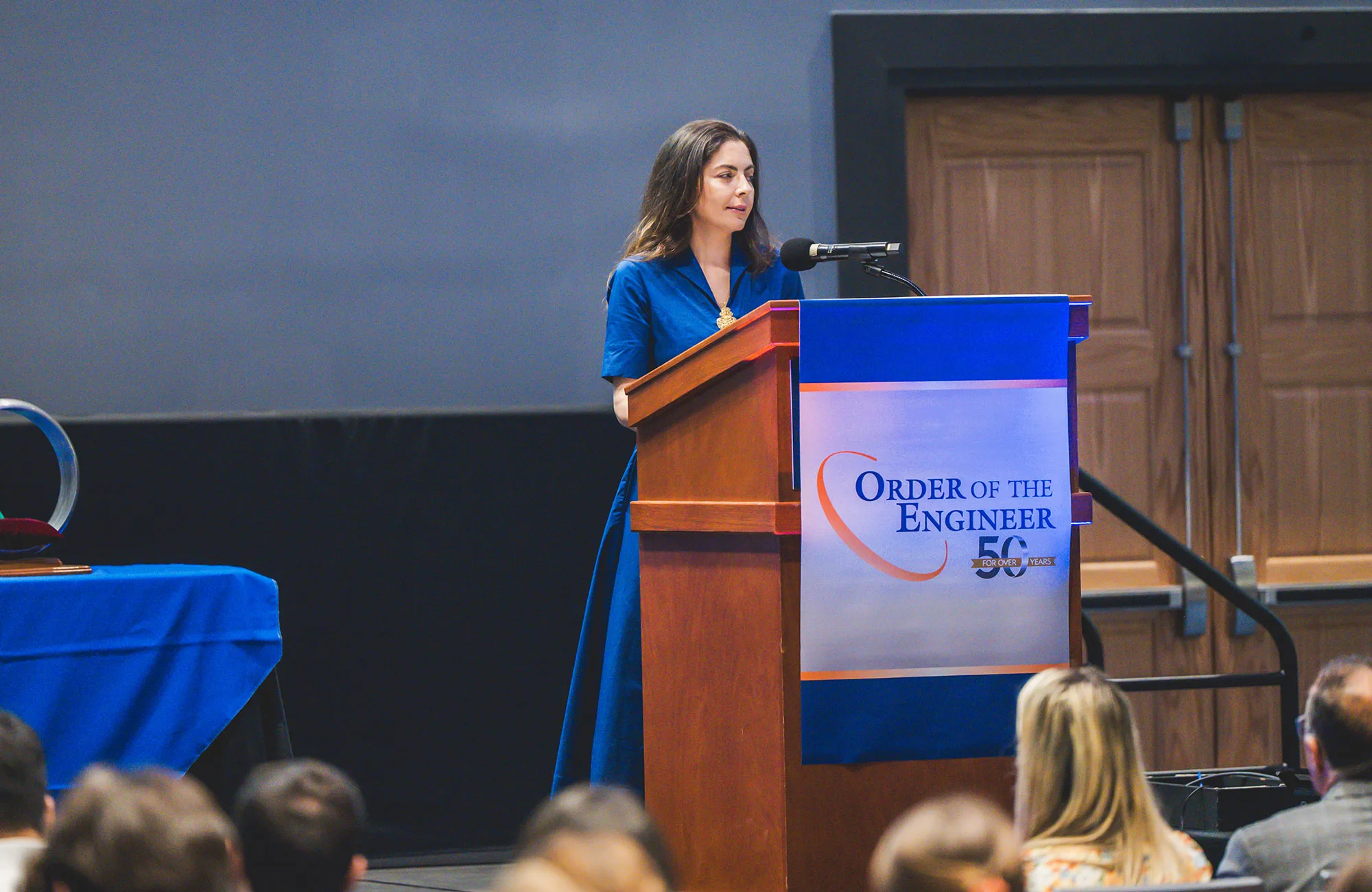
- Freda Zifteh earned her master’s degree in engineering from UF in 2005.
- In a recent address to students joining the Order of the Engineer, she reviewed key decisions in her career.
- She encourages students not to avoid chaos.
In May, University of Florida coastal engineering alumna Freda Zifteh — more than two decades removed from her student days — pulled no punches when addressing soon-to-be-graduating engineering students accepting the Order of the Engineer.
“Things,” she said, “are going to get messy.”
Messiness was a theme in her address. Zifteh (ME ’05) shared what she wished she had known at age 22. But, she assured the students, “Everything is still unfolding as it is meant to.”
“Not just career setbacks, but devastating, emotionally draining life setbacks, too. But I can look back and see that those moments shaped things that I wouldn’t dream of undoing now. You are writing the story of your life,” she said, “and you don’t need to avoid the chaos. The chaos is what makes it an interesting story.”
Zifteh’s own story is perhaps chaotic but definitely interesting.
She received her undergraduate degree in engineering science from UF in 2003, with a concentration in coastal and oceanographic engineering. Peter Scheng, Ph.D., professor in UF’s Department of Civil and Coastal Engineering, accepted Zifteh into his lab when she decided to pursue her master’s degree.
“He developed a numerical model, CH3D, that takes actual field data, applies boundary conditions and processes it through governing equations based on physics, predicting complex estuary circulation and water quality changes so engineers can make decisions and plans,” she recalled.
While still an undergraduate, Zifteh made two pivotal decisions. One, she earned a certificate in sales engineering from UF’s College of Engineering. Two, she began interning with the Army Corps of Engineers.
“It was a little bit of an internship-plus-plus,” she said. “We were collaborating with the Florida Water Management District on a project in the Everglades, and the professor whose work I was most interested in happened to have developed the model being deployed. The Corps said, ‘Go learn it.’”
After receiving her master’s degree, Zifteh parlayed her internship into a job with the Corps, where she helped implement the model her advisor developed.
The sales engineering certificate, now available as a full-blown curriculum minor, was at the time a new concept, introduced midway through her undergraduate studies.
“It was just out of pure interest,” she recalled. “I didn’t know what I was going to use it for. There was no clear path from coastal engineering to technical sales at the time, but I was just fascinated with the technical sales process.”
And then, after seven years with the Army Corps of Engineers as a coastal engineer, more chaos. Toward the end of Summer 2008, as she returned to work after having her first child and in the middle of a stock market crash, she noticed a job posting from Nortek, a company based in Norway that specialized in the development and manufacturing of acoustic Doppler instrumentation.
“It was a job in, again, technical sales. They wanted somebody in the southeastern United States familiar with the coastal engineering community, so it was like it was written for me,” she said.
Despite misgivings at the prospect of leaving a stable government job for a small, private foreign company, and after weeks of procrastination, she contacted the recruiter and asked about the position.
“He said, ‘We’ve already interviewed eight people in person. We’re actually ready to make an offer,’” she remembered.
The eight applicants had flown to New York City, enjoyed fancy dinners and Broadway shows. Zifteh felt like she had missed the boat. Not sure why, she proceeded to tell the recruiter about herself and her qualifications.
“I kind of spit everything at him,” she said. “Like, Army Corps of Engineers, Coastal Engineers, Southeast U.S., sales engineering certificate, everything. They had never even heard of that. They were like, ‘People study sales?’ At UF, they do.”
Guided by instinct, Zifteh pushed ahead.
“In a matter of 24 hours, I’d come up with a presentation, given it to him, given it to the president,” she said. “And then I got an offer from them.”
It all made sense to Zifteh. The coastal engineering experience, combined with the seemingly random sales engineering certificate, all conspired to land her in a position she enjoyed for 13 years.
By 2021, Zifteh was Nortek’s director of global marketing in Norway.
“If you could come up with the nerdiest version of ‘Emily in Paris,’ that was me coming into Nortek, the Norwegian company,” she said. “I look at that show, and I was just a worse-dressed version of Emily.”
Sounds messy.
In her address to UF’s Order of the Engineer honorees, she stressed that messiness and chaos are part of the journey.
“Some of you may go on to business school, and there, you’ll spend countless hours reading and picking apart case studies,” she told attendees. “Every mistake, every setback gets written as a brilliant strategy.
“Those brilliant moves … usually felt like failure at the time, like a door closing. And this is important, because you sit in forums like this and you sometimes get the false impression that the person speaking to you has it all figured out. They don’t. They are still writing their story.”
It was good advice, particularly for herself.
“I’m in one of those life moments — back against a wall, about to fall through it and maybe, hopefully, discover a new room on the other side,” she said.
Firmly in the middle of writing her life’s next chapter, Zifteh is still shaped by her time at UF.
Be they her leadership roles with the Society of Women Engineers or her experiences with the Benton Engineering Council, UF’s lessons continue to inform her career choices.
Zifteh went on to earn a Master of Business Administration from Boston University in 2021. Her résumé now includes vice president of marketing for General Oceans, a global portfolio of subsea technology companies, and co-founder & CEO of an autonomous subsea drone company.
But at her core, she is an engineer.
“I’m a builder, that’s the engineering part of me,” she declared. “I see something, and if it’s not working, I’m either gonna fix it or tear it up and rebuild it. And if it was working, then you probably didn’t bring me into it to begin with. I’m rarely going into a situation that’s working just fine, because I don’t pick situations that are working just fine. I pick ones that need some sort of something.”
In other words, she doesn’t mind getting messy.