
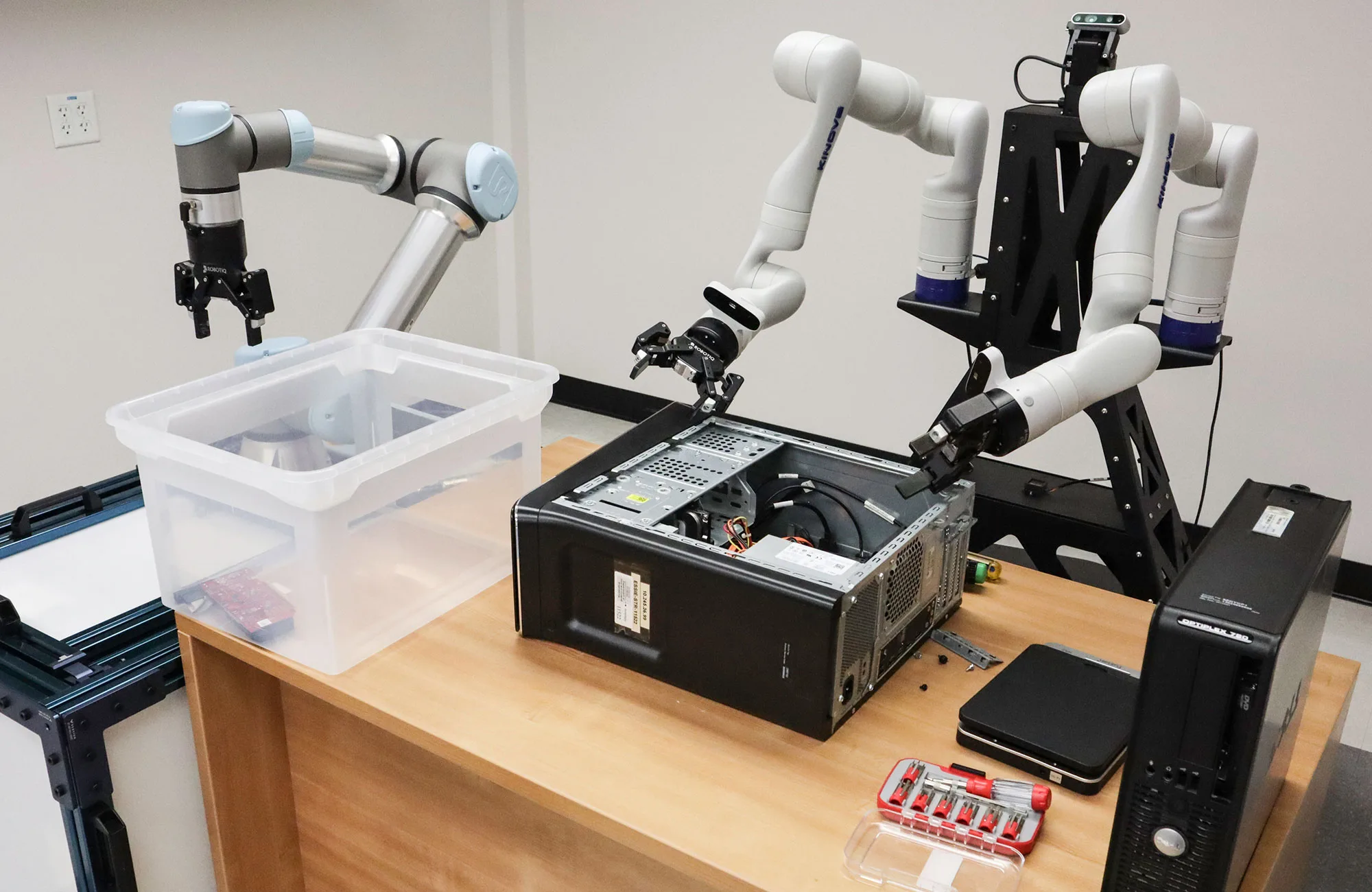
- Recycling e-waste and remanufacturing electronic components are extremely labor-intensive and can expose workers to unsafe conditions.
- Efforts to automate the process are hampered by variations in product designs, non-standardized joining methods and uncertain material and mechanical properties.
- UF’s Sara Behdad is leading a project to develop a self-learning digital twin to guide robots in disassembling consumer electronics for remanufacturing.
One strategy for moving toward a circular economy is ensuring that manufactured materials are in use for as long as possible through re-use, recycling and remanufacturing. In other words: Create less new stuff to reduce the manufacturing sector’s environmental impact.
In the case of electronics waste — or e-waste — remanufacturing and recycling is especially labor-intensive and inefficient. Circuit boards and motherboards are chock-full of different types and styles of computer chips and components. All these tiny, soldered components need to come off without damage in order to serve useful lives in other, remanufactured devices.
It’s tedious work with potentially toxic materials.
It’d be great if robots could do it, right?
Sara Behdad, Ph.D., thinks so, too.
With support from the National Science Foundation, known as NSF, Behdad and her collaborators plan to develop self-learning digital twins for robotic remanufacturing. The project, “Self-Learning Digital Twins for Robotic Remanufacturing under Uncertainty,” proposes a hybrid digital-twin framework that combines real-time sensing, physics-based simulation, AI-based models, reinforcement learning and robot execution to create a robotic system that can learn from the physical world and adapt to it while making real-time decisions in uncertain situations.
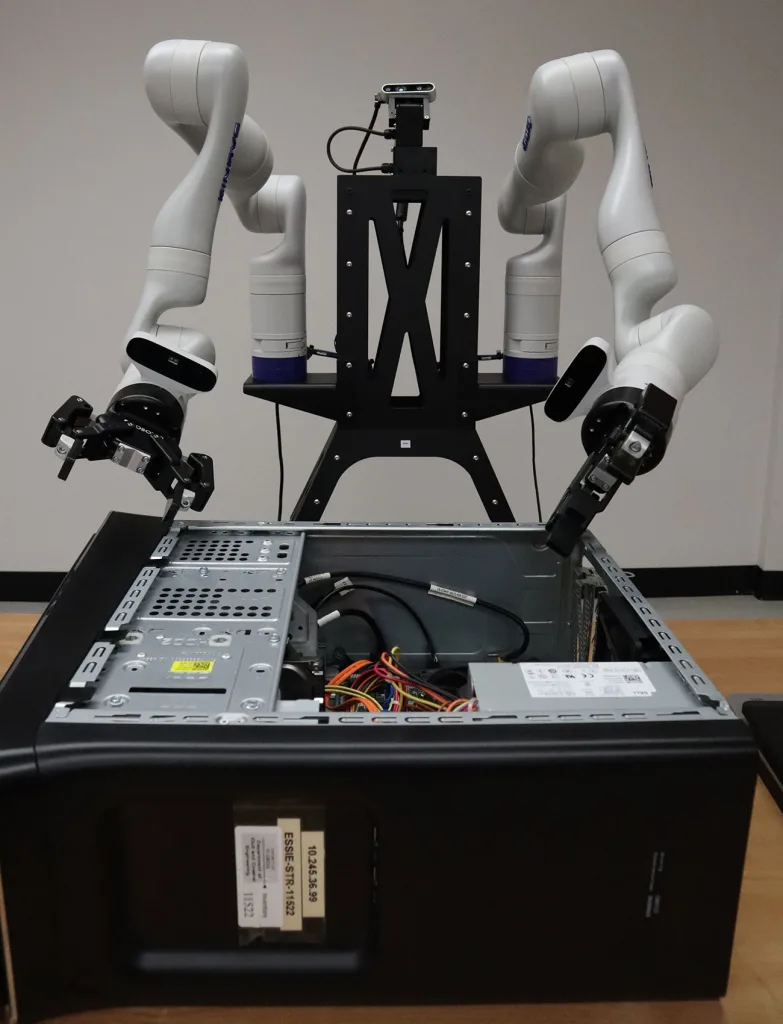
The end result will be a robotic disassembly testbed where consumer electronics are carefully dismantled by robots that are learning on the job.
“Often what we call recycling is really just material recovery; it’s not actual remanufacturing,” said Behdad, a professor in the University of Florida Department of Environmental Engineering Sciences. “In remanufacturing, what we hope to do is to harvest components and somehow reuse them, refurbish them. There’s actually lots of value that is put into the product when it’s manufactured, and simply just recovering the material is not the best solution.”
Remanufacturing is fundamentally different from conventional manufacturing because robots do not always know exactly what they will encounter, whereas in a manufacturing setting, the work is repetitive and predictable by design.
Used products can have different designs, levels of wear, damage, missing components or uncertain material and mechanical properties. A robot that has been programmed for one product or condition may struggle when it encounters something different. This makes robotic disassembly a particularly challenging environment for automation.
For Behdad, remanufacturing e-waste requires a single digital-twin system that combines physics-based simulation and AI-based models with data from the physical system.
A digital twin is a dynamic computational representation of an actual physical system — in this case, the product, robot and disassembly process. The system receives information from sensors such as cameras and force-torque sensors and uses this information to continuously update its understanding of what is happening during disassembly.
While high-fidelity physics-based models within digital twins can accurately simulate interactions in the physical world, in part because they incorporate the laws of physics (forces, contact, deformation and component separation), they can be too computationally expensive to run continuously while a robot is operating.
AI surrogate models, on the other hand, can make predictions much faster, but they may become unreliable when the robot encounters a product or condition that was not represented in their training data.
“With a digital twin, physics-based simulation and AI models are connected to the physical world through sensor data,” Behdad said. “But simulations are very time-consuming. Therefore, the idea was do we have to use simulation all the time, or can we actually switch to AI sometimes?”
The NSF project proposed combining physics-based models with AI-based models and developed methods that determine how much the system should rely on each one. The project will draw on HiPerGator, UF’s high-performance computing system, to support its computationally intensive simulations and AI models.
“We are developing a method to help the system decide how much to rely on physics-based models and how much to rely on AI-based models,” Behdad explained. “Based on the level of uncertainty, the system decides when to switch to AI, and when to switch to the physics-based model.”
In order to successfully program the robot to learn as it’s disassembling, the system relies on a type of reinforcement learning known as hierarchical reinforcement learning, where the AI model makes a decision and then makes a judgement about that decision.
“The idea is to have the model make two decisions,” Behdad explained. “One is a strategic decision, for example, which part should be removed. But there’s an additional decision about how the robot needs to behave to remove it. That’s an operational decision.”
UF is the lead institution for the project, joined by researchers from the University of California, Riverside and Florida International University, or FIU.
The UC Riverside team will focus on the physics-informed neural network tasked with awareness of the discontinuities during the disassembly process. Collaborators from FIU will focus on the specific programming of the decision-making process for the robotic system.
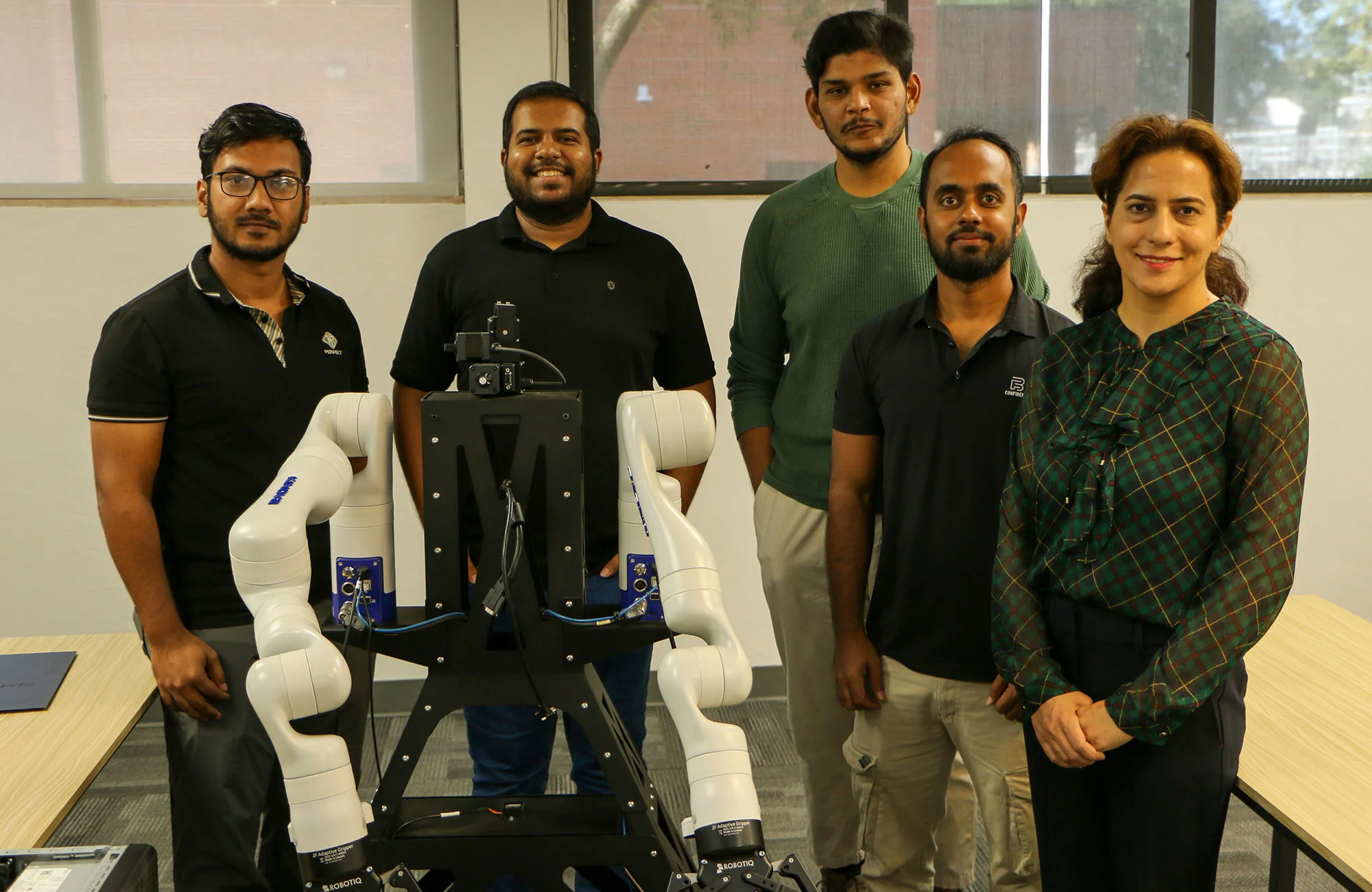
Graduate students in Behdad’s research lab are central to the project’s research and development efforts. They are developing computer vision models for product and component recognition, reinforcement learning methods for robotic decision-making, physics-based simulations of disassembly processes, and digital-twin capabilities that connect these models with the physical robotic system.
An additional motivation for the work is to reduce the need to source raw rare-earth elements from potentially vulnerable supply chains. Recovering materials during e-waste remanufacturing may reduce the need for newly sourced materials.