
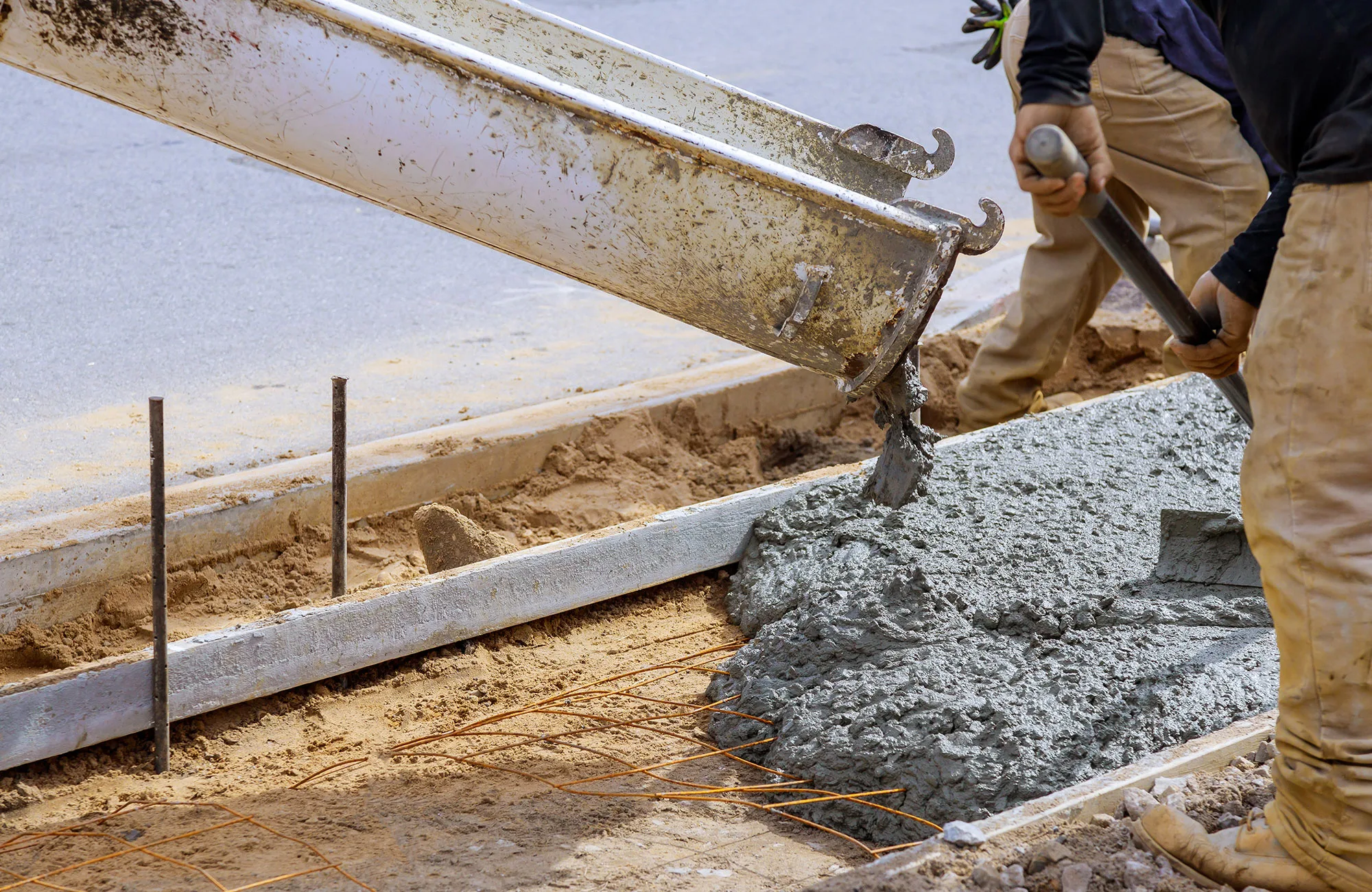
Other than water, Portland cement concrete is the most widely used material on the planet. As such, the materials used to make concrete have vast economic and environmental effects.
Christopher Ferraro, Ph.D., is passionate about developing concrete and cement that is stronger, more durable and less impactful on the environment. He’s an associate professor in the University of Florida’s Civil & Coastal Engineering Department, the associate director of UF’s Engineering School of Sustainable Infrastructure and Environment (ESSIE) and a self-described “quintessential tree hugger.”
In a $5 million project funded by the U.S. Department of Transportation, a team of researchers from UF, Rutgers University, Oregon State University and the New Jersey Institute of Technology are exploring the viability of using steel slag as an ingredient in cement and concrete. Ferraro is one of the project’s principal investigators.
Slag is a byproduct of steel production, a stony, molten waste material separated from metals during smelting or refining.
Using what is normally considered a waste product as a replacement for Portland cement in concrete means less mining of virgin materials, as well as reduced cost and environmental impact. Additionally, more durable and longer-lasting concrete requires less maintenance and replacement.
Ferraro is well known in civil engineering circles for his work with sustainable materials in infrastructure applications. Later this year, Ferraro will accept the American Concrete Institute’s Jean-Claude Roumain Innovation in Concrete Award.

Through this project, Ferraro ultimately wants to see construction projects utilizing concrete that is stronger and more sustainably produced while incorporating waste products.
Portland cement is rarely, if ever, used by itself, despite common parlance. Cement is a binding agent that, when mixed with sand and gravel in specific proportions, becomes concrete. Portland cement is the most common configuration of cement used in construction.
“So, we want to replace Portland cement in concrete as often as possible, for durability reasons,” Ferraro explained. “With Portland cement concrete without ash or a slag or other supplementary cementitious material, the chemistry does not lend itself well to long-term durability as it doesn’t create the densest microstructure, so deleterious solutions can get in there.”
By ash, Ferraro means coal fly ash, a waste product formed by the combustion of coal that has been used in the concrete industry for decades. As coal production slows down globally, alternative materials to replace fly ash are needed.
This five-year project is examining steelmaking slag produced in electric arc furnaces (hence, its name, EAF slag) to explore its use as a replacement for Portland cement or as a component in concrete. EAF slag is currently discarded as a waste material and is not recognized as a standard component in concrete by the construction industry. So-called slag cement, already an industry standard, utilizes blast furnace slag, which differs in composition from EAF slag.
“We’re basically asking, ‘Can we get EAF slag to be used like typical blast furnace slag?’” Ferraro said. “We have this material that’s being mostly just discarded, landfilled or stockpiled on site. Can it be beneficially reused as a construction material?”
Ferraro said adding EAF slag to concrete has the potential to enhance its durability.
“If slag is incorporated into the mixture, it has the potential to improve the underlying chemistry, enhance density and refine particle packing,” he explained. “So, we expect to see an improvement in long-term durability.”
Researchers will systematically evaluate EAF steel slag as a cementitious or blended constituent in concrete, focusing on structural adequacy, sustainability and durability. They plan to characterize the chemical and mineralogical content, as well as its stability and its tendency to expand.
The EAF slag concrete mixture will be evaluated based on criteria such as constructability, hydration/heat signature, strength and stiffness development, durability and cracking susceptibility using shrinkage testing — all compared to control mixtures with known behaviors.
“For me,” he said, “I’d like to see EAF slag being specified and utilized with the same level of confidence that slag cement is currently used so that it’s just another standardized material, another material used by the industry.”
For Rutgers University’s Tyler Oathes, Ph.D., an assistant professor in the Civil & Environmental Engineering Department, the project is all about transformation.
“This initiative aims to evaluate practical upcycling opportunities to transform an underutilized domestic byproduct into a strategic asset that strengthens the U.S. construction and manufacturing industries while reducing reliance on imports,” he said.